Guide solar panels oregonoregon shines rebatepge net meteringpacific power solaroregon solar incentives 2026

Solar Panels in Oregon: Oregon Shines Rebates, PGE and Pacific Power Net Metering

Oregon solar guide: Oregon Shines rebates, PGE and Pacific Power net metering, federal 30% tax credit, and payback timelines for homeowners in 2026.

 Β·  Updated  Β·  12 min read  Β·  By

Oregon homeowners who install solar panels in 2026 can expect to recover their investment in roughly 8 to 10 years β€” faster than the national average of 10.5 years tracked by NREL β€” thanks to a combination of state rebates, generous net metering rules, and the federal 30% Investment Tax Credit. The average 8 kW residential system costs about $24,000 before incentives and drops to around $16,800 after the federal credit alone. Add Oregon’s state programs on top and the numbers improve further.

The state’s electricity rates matter too. Oregon’s residential average sits near 12.4 cents per kilowatt-hour according to the U.S. Energy Information Administration (EIA), which is below the national average of roughly 16 cents. That sounds like a disadvantage for solar savings, but Oregon’s Pacific Northwest climate delivers more sunshine than most people assume β€” Portland averages 5.1 peak sun hours per day in summer, and southern cities like Medford and Ashland push closer to 5.8. The combination of moderate rates and solid sun hours still makes solar economics work, especially when net metering credits accumulate over 25-year panel lifespans.

This guide covers every major incentive available to Oregon residents in 2026 β€” the Oregon Shines rebate program, net metering rules at Portland General Electric and Pacific Power, federal tax credits, and the additional opportunities that come with pairing storage batteries or an EV charger with your solar array. Whether you are in Portland, Eugene, Bend, or Ashland, the core framework applies.
Oregon Shines Rebate: What It Pays and Who Qualifies

Oregon’s main state-level solar incentive is the Oregon Shines program, administered through the Oregon Department of Energy (ODOE). The program provides rebates of $0.30 per watt on residential solar installations, up to a maximum of $1,500 per household. For a typical 8 kW system, that works out to $2,400 β€” but because the cap is $1,500, most mid-size to large systems hit the ceiling. Smaller systems of 5 kW or less capture the full per-watt value.

To qualify for Oregon Shines in 2026, the installation must be completed by a contractor registered with ODOE, and the homeowner must be a customer of an Oregon-regulated utility. The rebate applies to grid-tied systems only β€” fully off-grid installations do not qualify. Applications must be submitted within 90 days of system completion, and rebate funds are approved on a first-come, first-served basis until the program’s annual allocation runs out, so submitting promptly after installation matters.

Income-qualified households can access an enhanced rebate tier. Homeowners at or below 80% of area median income (AMI) can receive up to $5,000, which transforms the economics significantly for lower-income families. ODOE partners with several community organizations to help households in this tier complete the application process and connect with registered installers in their area.

Oregon also previously offered an Energy Tax Credit, but that program closed to new applicants. The current state-level incentive landscape is anchored by Oregon Shines, which can be stacked on top of the federal 30% Investment Tax Credit. Using the solar tax credit calculator is a practical first step to model exactly what your combined federal and state credits will be based on your system cost and tax liability.

Comparing Oregon’s incentive stack to neighboring Washington is instructive β€” Washington eliminated its state sales tax on solar equipment but does not offer a direct rebate program. Oregon’s cash rebate approach is generally more accessible to households that do not pay significant state income tax, making it a more broadly useful benefit across income levels and financial situations.

PGE Net Metering: How Portland General Electric Credits Excess Solar

Portland General Electric serves roughly 900,000 customers across the Portland metro area and is the largest utility in Oregon by customer count. Under PGE’s current net metering tariff, solar customers receive a credit for every kilowatt-hour they export to the grid. As of 2026, PGE credits excess generation at the avoided cost rate, which sits around 4 to 5 cents per kWh β€” lower than the retail rate of roughly 12 cents but still meaningful over a full year.

This “net metering 2.0” structure replaced the older one-to-one net metering arrangement, meaning homeowners no longer receive a full retail-rate credit for every kWh exported. The shift incentivises systems sized to roughly match annual consumption rather than oversized arrays that export large volumes. PGE allows systems up to 25 kW for residential accounts, which is well above typical home needs.

PGE also runs a separate Solar Within Reach program for income-eligible customers, providing bill credits of around $20 to $30 per month for households that cannot install their own panels β€” a community solar option that extends solar benefits to renters and those with unsuitable rooftops. For more on this topic, see our guide to How Much Do Solar Panels Cost for a 2,000 Sq Ft Home?.

For homeowners who want to maximise the value of their solar production, adding a battery storage system changes the financial picture considerably. Instead of exporting excess power at the avoided cost rate, you store it and use it during evening peak periods when grid electricity is most expensive. Running the numbers with a solar net metering calculator shows clearly how much value is gained or lost depending on your export volumes and the specific credit rate your utility applies.

Billing under PGE net metering works on a monthly netting cycle. Credits that exceed your monthly bill are carried forward, and at the annual true-up in April, any remaining credit balance is paid out at the avoided cost rate. Systems that produce significantly more than they consume annually will see most of that excess value wiped out at true-up, reinforcing the case for right-sizing your system to match actual consumption rather than maximising raw output.

Pacific Power Net Metering: Rules for Eastern and Southern Oregon

Pacific Power, a subsidiary of PacifiCorp, serves customers across eastern Oregon, the Rogue Valley, and parts of the southern coast. Its net metering rules differ from PGE’s in several ways that solar buyers in those regions need to understand before choosing a system size.

Pacific Power’s residential net metering tariff credits exported energy at the full retail rate on a monthly basis β€” effectively one-to-one net metering β€” which is more generous than PGE’s avoided cost credit structure. For a household in Medford or Klamath Falls with strong summer sun, this one-to-one credit can improve annual savings meaningfully because excess summer production offsets winter bills at full value rather than a discounted export rate.

Pacific Power caps residential net metering systems at 25 kW AC, consistent with state rules. Interconnection for systems under 10 kW follows a simplified process with an application fee around $100. Larger systems between 10 and 25 kW go through a more involved review but typically complete within 30 to 60 days.

One important nuance for Pacific Power customers: the utility operates across multiple western states, and tariff details can vary by service territory. Oregon customers should verify current rates and credit structures directly with Pacific Power, as the company files periodic rate cases that can adjust the avoided cost calculations used in billing.

Southern Oregon’s solar resource is genuinely excellent. Medford averages about 196 sunny days per year, putting it ahead of cities like California’s Sacramento in raw sunshine hours. A well-sized system in the Rogue Valley under Pacific Power’s full retail net metering can produce payback periods closer to 7 to 8 years even at Oregon’s moderate electricity rates. For customers comparing utilities, the key difference in 2026 is that Pacific Power’s retail-rate net metering produces noticeably higher per-kWh export value than PGE’s avoided cost structure β€” a gap of roughly 7 to 8 cents per kWh that adds up to several hundred dollars annually for households that export significant volumes. For state-level payback data with the ITC applied, see our guide to Solar Panel Payback Period by State.

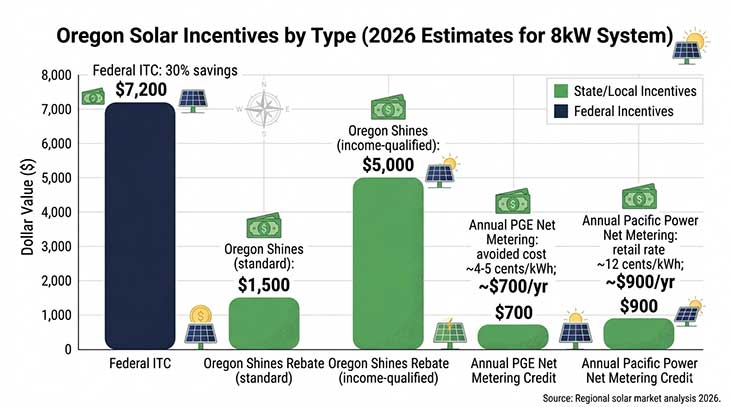
Bar chart comparing Oregon solar incentive values including federal tax credit, Oregon Shines rebate, and net metering savings
Oregon solar incentives stack to cut system costs by over 40%. On a $24,000 system, the 30% federal ITC saves $7,200, the Oregon Shines rebate adds up to $1,500, and net metering credits generate roughly $600–$900 per year over the system’s life. Source: ODOE, IRS, EIA 2026.

Federal Tax Credit and How to Claim It in Oregon

The federal Residential Clean Energy Credit β€” commonly called the Investment Tax Credit or ITC β€” is the most valuable single incentive available to Oregon solar buyers in 2026. It equals 30% of the total installed system cost, including panels, inverter, racking, wiring, and labor. On a $24,000 system, that is a $7,200 reduction in federal income tax owed β€” not a deduction from income, but a direct dollar-for-dollar reduction in your tax bill.

Claiming the credit requires filing IRS Form 5695 with your annual return. The credit applies to the tax year in which the system is placed in service β€” meaning the year installation is completed and the utility interconnection is approved. If your tax liability in that year is less than the full credit amount, the unused portion carries forward to subsequent tax years indefinitely under current law, so households with modest tax bills can still capture the full value over two or three filing years.

Battery storage systems are also eligible for the 30% credit when installed alongside solar, and since 2023, standalone battery systems not connected to solar also qualify under the Inflation Reduction Act provisions. A 10 kWh battery costing $10,000 installed produces an additional $3,000 federal credit on top of any solar credit claimed in the same year.

There are no income limits on the federal ITC β€” it applies equally regardless of household income, as long as you have federal tax liability to offset. The system must be installed at your primary or secondary residence in the U.S., and you must own the system outright. Systems purchased through a solar lease or power purchase agreement (PPA) do not qualify for the homeowner’s ITC because the leasing company claims it instead, which is one reason the purchase-versus-lease comparison deserves careful analysis before signing a contract.

States with strong incentive stacks like Oregon compare favorably to states like Idaho or Montana, which have limited state programs and lower electricity rates that stretch solar payback periods to 12 years or more. Oregon’s combination of state rebate, utility net metering, and the federal ITC puts it in a competitive tier with New York and Massachusetts for overall solar value, even though its electricity rates are below the national average.

Solar Installation Costs and Payback Timeline in Oregon

Understanding the full cost picture is essential before signing a solar contract. In Oregon, the average installed cost for residential solar sits between $2.80 and $3.20 per watt in 2026, according to SEIA data, putting a typical 8 kW system between $22,400 and $25,600 before incentives. After the 30% federal ITC, that range drops to $15,680 to $17,920. Factoring in the Oregon Shines rebate of up to $1,500 brings the effective net cost for most households to between $14,180 and $16,420.

Annual electricity savings depend on system output, local electricity rates, and how much of that production is used directly versus exported. A household in Portland with an 8 kW system and PGE service might save $900 to $1,100 per year on electricity bills. A comparable household in Medford under Pacific Power, benefiting from both more sun hours and retail-rate net metering, could save $1,100 to $1,400 per year. At those savings rates, payback falls between 10 and 12 years for PGE customers and 7 to 9 years for Pacific Power customers in the Rogue Valley.

System degradation is worth building into long-term projections. Most monocrystalline solar panels degrade at about 0.5% per year, meaning an 8 kW system will produce roughly 90% of its original output after 20 years. NREL research confirms that even accounting for degradation, Oregon homeowners typically accumulate $20,000 to $30,000 in lifetime electricity savings over a 25-year panel lifespan when the system is well-sized for the household’s consumption.

Comparing Oregon to other Pacific Northwest states, the economics are broadly similar to Washington but Oregon edges ahead due to the direct cash rebate. States like Arizona offer faster payback due to higher sun hours and electricity rates, but Oregon’s combined incentive structure remains one of the stronger packages in the western U.S. To model your specific address, system size, and utility, the solar savings calculator lets you enter Oregon-specific inputs and generates a full 25-year projection of costs and savings.

Frequently Asked Questions

How much does a solar system cost in Oregon after incentives in 2026?

A typical 8 kW residential system in Oregon costs around $24,000 before incentives. After the 30% federal ITC ($7,200) and the Oregon Shines rebate (up to $1,500), the net cost falls to approximately $15,300. Income-qualified households accessing the enhanced Oregon Shines tier of up to $5,000 can bring costs down to around $11,800. Actual costs vary by installer, equipment brand, and roof complexity.

Does Oregon have one-to-one net metering?

It depends on your utility. Pacific Power customers in eastern and southern Oregon receive full retail-rate credits for exported solar β€” effectively one-to-one net metering. Portland General Electric customers receive credits at the avoided cost rate, currently around 4 to 5 cents per kWh instead of the retail 12 cents. This difference can affect annual bill savings by $200 to $400 depending on how much a household exports each year.

What is the solar payback period in Oregon?

Most Oregon homeowners see a payback period of 8 to 10 years, according to NREL data. Pacific Power customers in high-sun areas like Medford can achieve payback closer to 7 years due to retail-rate net metering and a stronger solar resource. PGE customers in Portland typically land in the 9 to 11 year range. A 25-year panel warranty means the remaining years after payback represent essentially free electricity.

Can renters or condo owners access solar benefits in Oregon?

Yes, through community solar. PGE’s Solar Within Reach program provides monthly bill credits of $20 to $30 for income-eligible customers who subscribe to a shared solar project. Oregon also has a broader community solar program through ODOE that allows renters, condo owners, and homeowners with shaded roofs to subscribe to a portion of a larger off-site array and receive monthly credits on their utility bill.

Is the Oregon Shines rebate taxable income?

Oregon Shines rebates are treated as reductions in system basis for federal tax purposes. The IRS requires you to subtract the rebate from your system cost before calculating the 30% ITC β€” so on a $24,000 system with a $1,500 rebate, your ITC basis becomes $22,500, producing a credit of $6,750 rather than $7,200. At the state level, Oregon does not tax the rebate as income. Consult a tax professional to confirm your specific situation.

Data sources: U.S. Energy Information Administration (EIA) Electricity Data Browser 2025; National Renewable Energy Laboratory (NREL) PVWatts Calculator and Solar Payback State Data 2025; Solar Energy Industries Association (SEIA) Oregon State Solar Factsheet 2026; Oregon Department of Energy (ODOE) Oregon Shines Program Guidelines 2026; IRS Form 5695 Instructions 2025; Portland General Electric Schedule 84 Net Metering Tariff 2026; Pacific Power Oregon Net Metering Tariff Schedule 135 2026.

Data sources: U.S. Energy Information Administration (EIA) electricity rates Β· National Renewable Energy Laboratory (NREL) peak sun hours Β· Solar Energy Industries Association (SEIA) installation costs Β· IRS Publication 5695 (Investment Tax Credit) Β· Database of State Incentives for Renewables & Efficiency (DSIRE). All calculations are estimates. Consult a licensed solar installer for precise quotes.