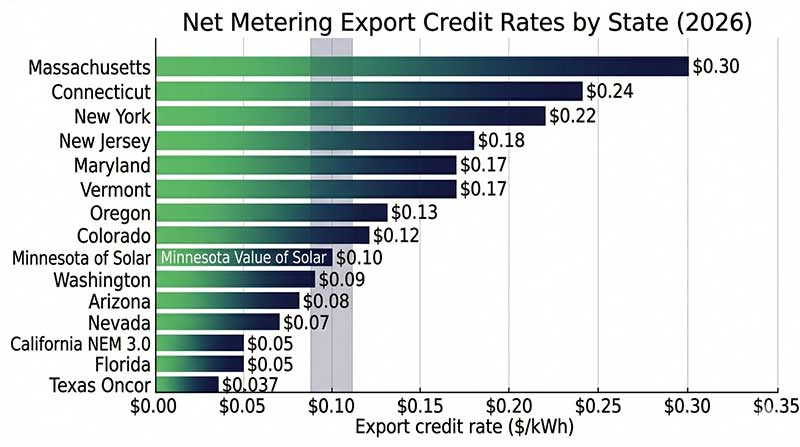
At least 41 states plus Washington D.C. currently have some form of net metering policy, but what that actually means for your electricity bill varies enormously from one border to the next. A solar homeowner in Massachusetts can earn a retail-rate credit of roughly $0.30 per kilowatt-hour for every unit they export to the grid, while a homeowner in Idaho might receive as little as $0.04 per kWh under an avoided-cost structure β a difference that can shift the payback period on an identical system by five years or more.
Net metering is the billing arrangement that lets solar panel owners send surplus electricity back to the utility and receive a credit against future consumption. The underlying concept is simple, but the rules governing credit rates, carryover periods, monthly true-ups, and eligible system sizes have become a patchwork of state commission orders, legislative mandates, and utility tariffs that change almost every year. SEIA tracks active policy proceedings in more than a dozen states in 2026 alone.
This guide breaks down the key variables that actually affect your return on investment: the credit rate structure, the annual true-up treatment, any capacity caps, and recent or pending changes. Whether you are deciding when to go solar or trying to understand a utility bill credit, the comparisons below give you a clear baseline for every state.
How Net Metering Credit Rates Actually Work
The single most important number in any net metering policy is the credit rate β the dollar value assigned to each kilowatt-hour you export. Policies generally fall into three tiers.
Full retail rate means the utility credits your export at the same price you would pay to buy that same kilowatt-hour back. If your retail rate is $0.18/kWh, you earn $0.18 for every kWh you send to the grid. This is the most generous structure and the original model used when net metering began in the 1990s.
Avoided-cost rate (also called the wholesale rate) credits exports at only what the utility would have paid to generate or procure that electricity elsewhere β typically $0.03 to $0.07/kWh in most regions. The gap between retail and avoided-cost can be enormous. In California, the transition from retail-rate NEM 2.0 to NEM 3.0 cut the average export credit from roughly $0.30/kWh to about $0.05/kWh, a reduction of over 80%. SEIA reported that California’s NEM 3.0 transition, which took effect for new applicants in April 2023, shifted the payback period on a typical 6 kW system from approximately 6 years to 9β11 years.
Value of Solar tariffs represent a third approach used by a small number of utilities, most notably in Minnesota and some Texas co-ops. Under these programs, exports are credited at a rate calculated annually based on avoided fuel costs, capacity value, line-loss savings, and sometimes environmental attributes. Minnesota’s Value of Solar rate was set at $0.1048/kWh for 2024, placing it between full retail and pure avoided cost for most customers.
The practical implication: running a solar net metering calculator with accurate local credit rates is essential before signing any installation contract, because two identical 8 kW systems in neighboring states can produce annual bill savings that differ by $800 or more purely because of credit rate policy.
True-up periods also matter. Most states allow unused monthly credits to roll forward and be settled once a year. A few states require monthly settlement, which disadvantages solar owners in northern climates who overproduce in summer and draw heavily from the grid in winter. New Hampshire uses a monthly true-up that can reduce the effective value of a residential solar system by 10β15% compared to an annual true-up structure, according to state PUC filings.
States With the Strongest Net Metering Policies in 2026
Several states have maintained or recently strengthened full retail-rate net metering, and they consistently appear at the top of solar payback analyses conducted by NREL and state energy offices.
Massachusetts has one of the most favorable net metering structures in the country. The state credits residential exports at full retail rates up to 10 kW for standard customers, with a 12-month rolling credit carryover. The average retail rate in Massachusetts reached $0.30/kWh in early 2026, making each exported kWh highly valuable. The state also runs separate Solar Massachusetts Renewable Target (SMART) incentive payments stacked on top of net metering credits, though SMART capacity blocks for the most popular utilities are filling quickly.
New Jersey maintains full retail-rate net metering with no statewide capacity cap on residential systems. The state’s average retail rate of $0.18/kWh and a 12-month carryover policy have helped push average residential solar payback periods to around 7β8 years, well below the national average of 10β12 years. New Jersey’s Solar Renewable Energy Certificate (SREC-II) program further improves economics, though SREC prices fluctuate quarterly. To see how your state compares, our guide to Solar Panel Payback Period by State has the full data.
Maryland passed legislation in 2023 that locked in full retail-rate net metering through at least 2028 for existing and new residential customers, providing policy certainty that is rare in the current environment. The state caps individual systems at 200% of average annual consumption β a threshold generous enough that virtually no residential customer will hit the limit.
Vermont uses a net metering credit equal to the full retail rate minus a small distribution charge adder, which effectively delivers about 90% of the retail rate value. Vermont’s compact geography means most utilities serve relatively uniform customer bases, which has limited the utility opposition that has driven reform efforts in larger states.
Oregon passed House Bill 2618 in 2023, preserving retail-rate net metering for residential customers and capping utility-proposed reforms until 2028. The bill required the Oregon PUC to complete a full cost-allocation study before any rate structure changes can take effect, adding several years of procedural buffer. States with strong policies share two common traits: relatively high retail electricity rates and legislative decisions that have held off utility pressure to shift to avoided-cost structures.
States Where Net Metering Has Been Cut or Is Under Pressure
The states on the other side of the ledger are places where policy has already shifted against solar exporters, or where utility filings make a shift likely in 2026β2027.
California’s NEM 3.0 is the most widely analyzed case. The California Public Utilities Commission approved the new structure in December 2022, cutting average export credits by more than 75% for new applicants. Systems installed before April 15, 2023 were grandfathered under NEM 2.0 for 20 years, creating a two-tier market that still shapes resale values of homes with existing panels. Under NEM 3.0, California has pushed solar-plus-battery systems as a workaround, since pairing storage with panels allows homeowners to shift self-consumption to evening peak hours when retail rates are highest under time-of-use tariffs. NREL modeled that a battery-paired system under NEM 3.0 can recover roughly 60β70% of the bill savings lost from the export credit reduction.
Nevada went through its own net metering crisis in 2015β2016 when the PUC cut export credits from retail rate to near avoided cost. After significant political backlash and a 2017 ballot measure restoring stronger net metering, the state implemented a phased reduction schedule: credits decline from roughly 95% of retail to 75% of retail over a period determined by cumulative installed capacity milestones. Nevada currently sits at the 75% level for most residential customers, with the next reduction trigger tied to an 80 MW cumulative capacity threshold.
Florida passed Senate Bill 1024 in 2022, which eliminated full retail-rate net metering for new customers starting in 2024. Existing customers keep full retail credits until 2029. New applicants now receive an avoided-cost credit, currently approximately $0.04β0.06/kWh depending on the utility. The Florida Solar Energy Center estimated this change extended average solar payback periods from roughly 9 years under the old policy to 12β14 years under the avoided-cost credit structure.
Texas has no statewide net metering mandate. Policies are set at the utility level, and most investor-owned utilities in the ERCOT market offer buyback rates well below retail. Oncor, which serves the DallasβFort Worth area, offers a buyback rate of approximately $0.037/kWh β about one-fifth of the average retail rate paid by customers β making battery storage pairing essentially mandatory for strong solar economics in that territory.

Capacity Caps, Carryover Rules, and System Size Limits
Beyond the credit rate, three secondary policy details can significantly alter the value of a residential solar installation: system size caps, annual carryover rules, and aggregate capacity limits at the utility level.
System size limits are typically set as a percentage of annual consumption or as an absolute kW ceiling. Most states allow systems sized at 100β120% of annual average load. A few states are more restrictive: Georgia allows systems up to 10 kW for residential customers under the main net metering tariff, which limits the economics for larger homes with higher consumption. Colorado allows up to 120% of annual consumption with no hard kW cap for residential customers, which is favorable for households that have added electric vehicles or heat pumps and significantly increased their annual load.
Annual versus monthly true-up determines what happens to accumulated credits at settlement. Under annual true-up, a homeowner who overproduces in summer builds up credits that offset winter bills at full credit value. Under monthly true-up, any credit above consumption is zeroed out or paid out at a low avoided-cost rate at month end. EIA analysis shows that the difference in effective annual savings between annual and monthly true-up can run $200β$400 per year for a typical northern-state solar system that produces roughly 40% more electricity in summer than in winter.
Aggregate caps set a ceiling on how much solar capacity utilities must accept under net metering tariffs β typically expressed as a percentage of the utility’s peak demand. Hawaii, which hit its aggregate caps years ago, was the first state to move entirely away from traditional net metering to the Customer Self-Supply and Customer Grid-Supply programs. The grid-supply export rate in Hawaii currently runs $0.18β0.23/kWh depending on island and utility β lower than the retail rate of $0.40 or more per kWh, but still significantly higher than mainland avoided-cost rates.
Running a solar payback calculator with your actual utility’s tariff rates β not just statewide averages β is the most reliable way to translate these policy variables into a real payback timeline for your specific home. EIA data shows that retail electricity rates within a single state can vary by 20β30% between different utility service territories, adding another layer of variability on top of the net metering structure itself. For homeowners in states with weak export credits, pairing solar with battery storage improves economics by increasing self-consumption during peak-rate hours. Using a battery storage calculator to model how much of your daily export could instead be stored and discharged in the evening can show whether the added cost of storage is justified given your utility’s buyback rate.
What Net Metering Policy Changes Mean for Your Solar Decision
If you are evaluating solar in 2026, the trajectory of net metering policy in your state matters almost as much as the current rules, because most solar systems operate for 25β30 years and the policy environment will almost certainly evolve during that window.
The general direction nationally has been toward lower export credits and cost-of-service reforms driven by utility arguments about fixed-cost recovery and grid infrastructure maintenance. The Edison Electric Institute, which represents investor-owned utilities, has argued in PUC proceedings across multiple states that retail-rate net metering creates a cost shift onto non-solar customers of $1β3 billion per year nationally. Solar advocates contest both the methodology and magnitude of those figures, but the regulatory and legislative trend since 2020 has clearly moved toward rate structure reforms in larger states, particularly those with higher solar penetration rates above 5% of retail load.
That said, the pace of change varies enormously. States with strong solar advocacy organizations and favorable legislative climates β New York, New Jersey, Oregon, Colorado, and Illinois β have successfully blocked or delayed utility-backed reform proposals. States with weaker consumer protection frameworks or utility-friendly commissions β Georgia, Arizona post-2017, and parts of the Southeast β have moved faster toward reduced credits.
Illinois is a notable recent example moving in the opposite direction: the 2021 Climate and Equitable Jobs Act locked in full retail-rate net metering for new residential customers and added a credit adder for low-income solar installations. Illinois retail rates averaging around $0.14/kWh in 2026 make it a strong policy environment for new solar through at least the late 2020s.
If you are in a state with a grandfathering provision β California, Florida, and Nevada all have versions of this β and the window for grandfather eligibility is still open, there is a meaningful financial argument for moving quickly. Grandfathered customers in California under NEM 2.0 are estimated to receive $5,000β$8,000 more in lifetime bill savings than equivalent systems installed under NEM 3.0, according to analysis by the California Solar and Storage Association. EIA projects retail electricity rates will increase nationally by an average of 2β3% per year through 2030, which improves solar economics over time but does not offset the impact of a major net metering restructuring for new customers.
Before committing to a contract, use a solar ROI calculator that inputs your state’s specific credit rate, local retail rate, and a conservative future rate escalation scenario β it is the most reliable way to judge whether the economics work under your current state policy before signing anything.
Frequently Asked Questions
What is net metering and how does it affect my solar bill?
Net metering lets you send excess solar electricity to the grid and receive a bill credit in return. Most states offer credits at or near the full retail rate, meaning a kilowatt-hour exported is worth the same as one you would have purchased. On a net-zero solar month, your bill covers only fixed service charges β typically $10β$25 depending on your utility.
Which states have the best net metering policies in 2026?
Massachusetts, New Jersey, Maryland, Vermont, and Oregon consistently rank at the top because they offer full retail-rate credits, 12-month carryover, and no restrictive system size caps. Massachusetts averages $0.30/kWh in export credits β the highest of any state β making solar payback periods as short as 5β7 years for well-sited systems.
Does California still have net metering for new solar customers?
Yes, but the structure changed significantly. New California customers installed after April 15, 2023 receive NEM 3.0 credits averaging around $0.05/kWh for exports β down from roughly $0.30/kWh under NEM 2.0. Systems installed before that date are grandfathered under NEM 2.0 for 20 years. NEM 3.0 economics generally require pairing solar with battery storage to make financial sense.
What happens to my net metering credits if I move or sell my house?
In most states, net metering interconnection agreements transfer with the property, not the customer. A home with an existing solar system typically retains its current net metering tariff when sold. California explicitly allows NEM 2.0 grandfathered status to transfer to new owners, adding estimated resale value of $3,000β$5,000 based on the remaining protected credit period.
Can net metering policies change after I install solar?
Yes, though most states have grandfathering provisions protecting existing customers for 10β20 years. Florida grandfathers pre-2024 installations through 2029. California’s NEM 2.0 grandfathering runs 20 years from the interconnection date. Nevada’s grandfathering covered 20 years from its 2015 policy change. A 15β20 year protected window covers most of the financially critical payback period for a typical residential system.
Data sources: U.S. Energy Information Administration (EIA) Electric Power Monthly, April 2026; Solar Energy Industries Association (SEIA) Solar Spotlight state policy database, Q1 2026; National Renewable Energy Laboratory (NREL) Solar-Plus-Storage Modeling Report 2024; California Public Utilities Commission NEM 3.0 Decision 22-12-056; Florida Solar Energy Center Net Metering Impact Analysis 2023; Minnesota Department of Commerce Value of Solar tariff rate schedule 2024; California Solar and Storage Association NEM 2.0 vs NEM 3.0 Lifetime Savings Analysis 2024.