Guide federal solar tax credit 2026itc 2026solar incentivesresidential solarsolar tax credit

Federal Solar Tax Credit 2026: The Complete Guide to the 30% ITC

How the 30% federal solar tax credit works in 2026, which costs qualify, how to claim it on Form 5695, and how to stack it with state incentives for maximum savings.

 Β·  Updated  Β·  13 min read  Β·  By

The federal solar Investment Tax Credit (ITC) lets US homeowners cut 30% directly off their federal tax bill when they install a qualifying solar system β€” and in 2026 that credit is fully intact at its maximum rate. For the average residential system costing around $28,000 before incentives, that works out to an $8,400 reduction in what you owe the IRS. It is the single most valuable financial tool available to homeowners going solar, and yet IRS data consistently shows that eligible households either claim it incorrectly or fail to plan around it properly.

This guide covers everything you need to know about the 30% ITC in 2026: what exactly qualifies, how the credit interacts with your tax liability, which additional costs are covered beyond just the panels, and how to combine it with state-level incentives to drive your net cost even lower. The credit was extended and expanded under the Inflation Reduction Act of 2022, and under current law the 30% rate holds through 2032 before stepping down to 26% in 2033 and 22% in 2034.

Understanding the numbers before you sign an installer contract is what separates homeowners who genuinely capture the full value of this incentive from those who leave money on the table. Use our solar tax credit calculator to run your own figures before reading the fine print below.
What the 30% Federal Solar Tax Credit Actually Covers

The residential ITC is authorised under Section 25D of the Internal Revenue Code, and the IRS has been clear about what qualifies. The credit applies to 30% of the total installed cost of a solar photovoltaic system, but “installed cost” is broader than most homeowners assume.

Eligible costs include the solar panels themselves, labour for installation, permit fees, inspection costs, and any electrical upgrades your home requires to connect the system safely. Mounting hardware, inverters, wiring, and monitoring equipment all count. A battery storage system qualifies for the full 30% credit in 2026 even if it is installed separately from your solar panels, as long as the battery is used in a residential setting β€” a change introduced by the Inflation Reduction Act that substantially expanded battery adoption nationwide.

What does not qualify: the cost of roof repairs made necessary before the solar installation, any portion of a system financed through a solar lease or power purchase agreement, and installation on a property that is not your primary or secondary residence. A new roof installed as an integral structural component of the solar system may partially qualify, but this is a nuanced IRS question best confirmed with a tax professional before you proceed.

According to SEIA (the Solar Energy Industries Association), the average US residential solar installation in 2025 was approximately 8.5 kilowatts in capacity and cost between $24,000 and $32,000 before incentives. At $28,000, the 30% ITC delivers an $8,400 credit. If you are also adding battery storage β€” say, a single unit adding $10,000 to the project β€” the eligible credit grows to $11,400 on a $38,000 combined project. Running those numbers through our solar savings calculator will show how that upfront credit reshapes your payback timeline from year one.

One structural point worth understanding clearly: this is a tax credit, not a tax deduction. A deduction reduces the income you are taxed on; a credit reduces the actual tax you owe dollar for dollar. That distinction matters enormously in practical financial terms, because a 30% credit on a $28,000 system is worth $8,400 in direct tax reduction, whereas a $28,000 deduction for a household in the 22% bracket would reduce taxes by only $6,160.

How the ITC Works Against Your Federal Tax Liability

The most common source of confusion about the federal solar tax credit is the question of tax liability. The credit does not create a refund β€” it offsets taxes you already owe. If your federal income tax bill for 2026 is $6,000 and your ITC is $8,400, you will reduce your 2026 tax bill to zero, but you will not receive the remaining $2,400 as a cash refund. Instead, that unused $2,400 carries forward to your 2027 tax return under the carryforward provision, and it continues rolling forward until it is fully used.

This carry-forward feature makes the credit viable even for homeowners with modest tax bills, but it does require planning. Homeowners who are retired and live primarily on Social Security income, or who have very low taxable income for other reasons, may find they cannot fully use the credit within a reasonable timeframe. In those cases, the financial case for solar still exists, but it is weaker than for households with substantial ongoing federal tax liability.

The IRS requires you to claim the credit using Form 5695 (Residential Energy Credits). The form walks through the calculation and feeds the result directly into Schedule 3 of your Form 1040. Most major tax software handles this automatically, but you must retain documentation: your installer’s final invoice, permit records, and proof of system commissioning date. The system must be placed in service β€” switched on and operational, not merely contracted or installed β€” during the tax year you claim the credit.

For homeowners who financed their system through a solar loan rather than a cash purchase, the ITC still applies to the full system cost, not just the down payment. A homeowner who puts $3,000 down on a $30,000 system still claims a $9,000 credit at 30%, and many homeowners use that credit to make a large extra principal payment in year one, shortening the loan term considerably. Our solar loan calculator can model exactly how that plays out across different interest rates and loan terms, giving you a clear picture of total cost of ownership.

State Incentives You Can Stack on Top of the Federal Credit

The federal ITC does not prevent you from claiming state tax credits, utility rebates, or net metering benefits on top of it β€” and in many states the combined package of incentives makes solar substantially more affordable than the federal credit alone suggests.

California offers one of the most developed incentive landscapes in the country, though its net metering structure changed significantly in 2023 under NEM 3.0, reducing the per-kilowatt-hour export rate for new systems. Despite that shift, the state’s Self-Generation Incentive Program (SGIP) still provides meaningful battery storage rebates that compound with the federal ITC. New York runs a 25% state solar tax credit capped at $5,000, which layers directly on top of the federal 30%, bringing combined credits to as high as 55% of system cost for qualifying installations.

Texas has no state income tax and therefore no state solar tax credit, but a property tax exemption on the added home value from a solar installation partially compensates β€” and given that solar typically adds $15,000 to $25,000 in appraised home value in Texas, that exemption carries real weight. Massachusetts provides a 15% state credit capped at $1,000, plus access to the SMART programme for ongoing solar incentive payments spread over ten years. Arizona offers a 25% residential solar tax credit capped at $1,000 along with a sales tax exemption on solar equipment purchases.

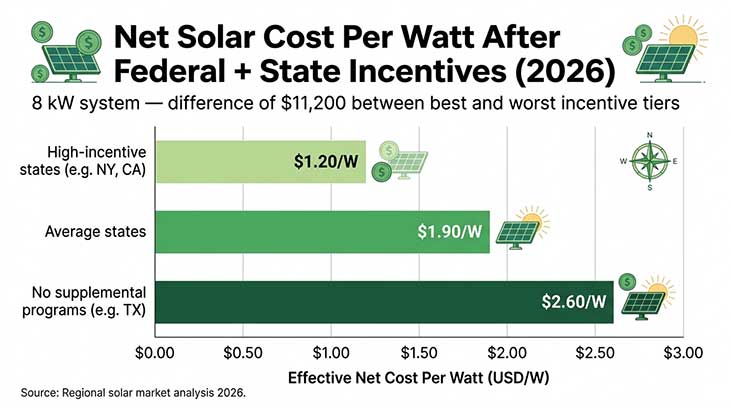
According to NREL (the National Renewable Energy Laboratory), the effective net cost of residential solar after all incentives β€” federal, state, and utility β€” varies from approximately $1.20 per watt in the most incentive-rich states to around $2.60 per watt in states with no supplemental programmes. That spread of more than $1 per watt on an 8 kW system represents a difference of over $11,000 in net cost. Our IRA rebate calculator helps homeowners map out the full incentive stack available in their specific location.

Utility rebates are treated differently from tax credits when calculating your ITC. Most utility rebates reduce your system’s tax basis β€” meaning if you receive a $2,000 utility rebate on a $30,000 system, your ITC is calculated on $28,000 rather than the full $30,000. State tax credits, by contrast, do not reduce your federal ITC basis, which is why state-plus-federal stacking is so financially powerful in states like New York.

Horizontal bar chart comparing effective net solar cost per watt by incentive tier: incentive-rich states at $1.20/W, average states at $1.90/W, no-supplemental-program states at $2.60/W
Effective Net Solar Cost Per Watt After All Incentives (2026) NREL data shows a spread of more than $1.40 per watt between the most and least incentive-rich states, translating to over $11,000 in net cost difference on an 8 kW system. Source: National Renewable Energy Laboratory residential solar cost data, 2024.

Common Mistakes That Cost Homeowners Thousands of Dollars

Even with a straightforward 30% rate, there are several ways to reduce or lose the credit entirely through avoidable errors.

The most costly is misunderstanding the “placed in service” rule. A system signed, paid for, and physically installed in December 2026 that is not switched on and inspected by your utility until January 2027 is a 2027 credit, not a 2026 credit. The calendar year in which the system is officially operational governs your claim. Homeowners who rush to sign contracts in December to capture the credit that tax year need to confirm with their installer that commissioning β€” not just panel mounting β€” will complete before December 31.

Choosing a solar lease or power purchase agreement (PPA) is another way to forfeit the credit entirely. Under a lease, you do not own the solar equipment; the leasing company does, and they claim the ITC. Your benefit under a lease is a lower monthly electricity cost, but you receive none of the federal tax credit value. On a $28,000 system, that is $8,400 you are effectively transferring to the leasing company. Understanding the full 20-year financial comparison between leasing and buying β€” including the ITC transfer β€” is essential before signing any agreement.

Failing to track and document all eligible project costs is a subtler error but a common one. Homeowners who rely on memory rather than their final itemised invoice routinely under-claim by $500 to $1,500 by forgetting permit fees, electrical panel upgrades, or monitoring system costs. Keep every invoice and receipt from the project, including items that seem incidental.

Finally, claiming the credit in a year where your tax liability is zero β€” without understanding the carryforward mechanism β€” leads some homeowners to believe they lost the credit entirely. They have not: it carries forward indefinitely under current law. But failing to file Form 5695 correctly in subsequent years can create reconciliation problems. The IRS carryforward provision means homeowners with low-tax years in 2026 can still fully recover the credit value in 2027 and 2028, as long as Form 5695 is filed accurately each year. If your tax situation involves variable income, rental properties, or significant deductions, a CPA familiar with residential energy credits is a worthwhile investment before you file.

How to Calculate Your Real Payback Period After the Federal ITC

The ITC does not make solar free, but it significantly compresses the payback timeline. NREL’s 2024 data found that the median payback period for a US residential solar system without incentives was approximately 9.5 years. With the 30% ITC applied, that falls to roughly 6 to 7 years for most homeowners β€” and in high-electricity-cost states it can be as short as 4 to 5 years.

The payback calculation depends on four variables: your net system cost after the ITC and any state incentives, your current annual electricity cost, the percentage of that bill offset by solar production, and the rate at which electricity prices increase over time. EIA (the US Energy Information Administration) projects a long-run average retail electricity price increase of approximately 2% to 3% per year, though some regions β€” particularly the Northeast and Hawaii, where residential electricity averages over 40 cents per kilowatt-hour β€” have historically seen faster increases.

For a concrete example: a homeowner in Colorado installs an 8 kW system for $28,000, claims an $8,400 ITC, and carries a net cost of $19,600. Per NREL’s PVWatts tool, that system produces roughly 10,400 kWh per year given Colorado’s sun hours, offsetting approximately $1,560 in annual electricity costs at $0.15 per kWh. Factoring in a 2.5% annual electricity price increase and 0.5% annual panel degradation, the payback period works out to approximately 10 to 11 years β€” and the system’s 25-year projected net savings still exceed $28,000.

The 30% ITC is particularly effective when combined with net metering, which allows homeowners to export excess solar electricity to the grid and receive bill credits in return. States with strong net metering policies ensure that every kilowatt-hour your panels produce carries a defined financial value, accelerating payback even in lower-sunlight months. To model your specific numbers β€” including local utility rates, available sun hours, and the exact impact of the federal solar tax credit on your timeline β€” use the solar payback calculator before committing to a system size or installer quote.

Frequently Asked Questions

Can I claim the federal solar tax credit if I don’t owe federal taxes?

If your federal tax liability is zero in the year you install solar, you cannot use the credit that year β€” but it does not disappear. The ITC carries forward automatically to future tax years under current IRS rules, with no expiration through 2032 under the Inflation Reduction Act. You apply the unused balance in subsequent years until it is fully consumed. Homeowners with consistently low tax bills should factor this carry-forward timeline into their payback calculation.

Does the 30% solar tax credit apply to battery storage installed without solar panels?

Yes, since the Inflation Reduction Act of 2022. Standalone battery storage systems installed from January 1, 2023 onward qualify for the 30% ITC under Section 25D, even without co-located solar panels, provided the battery is used at a residential property. Prior to 2023, batteries only qualified if charged exclusively by solar. A standalone 10 kWh battery costing $10,000 installed in 2026 therefore generates a $3,000 federal tax credit entirely on its own.

What is the difference between the residential ITC and the commercial solar tax credit?

The residential ITC (Section 25D) applies to primary and secondary residences and is claimed as a personal tax credit on Form 5695. The commercial credit (Section 48) applies to businesses, rental properties, and commercial solar installations and functions as a business investment tax credit with different qualification rules and bonus adders. A rental property you own is generally a Section 48 installation rather than Section 25D, so different rates and eligibility conditions apply.

Will the federal solar tax credit remain at 30% after 2026?

Under current law, the ITC stays at 30% through December 31, 2032. It then steps to 26% in 2033 and 22% in 2034, after which it expires for residential systems. Congress has modified this credit multiple times β€” including extending and expanding it in 2022 β€” so future legislative changes remain possible. Homeowners planning to install solar have a strong financial incentive to act before 2033, when the first step-down takes effect and the credit drops by 4 percentage points.

Can I claim the ITC if I managed my own solar installation rather than hiring a turnkey company?

Yes. The ITC applies based on system ownership, not installer type. If you purchase equipment yourself and hire separate contractors for installation, all eligible costs β€” panels, inverters, labour, permits, and required electrical upgrades β€” count toward the 30% credit. Retain itemised documentation from every supplier and contractor involved. Self-managed installs are fully valid under IRS rules and can reduce total project cost, increasing the absolute dollar value of the credit you claim.

Data sources: IRS Form 5695 instructions and Section 25D of the Internal Revenue Code; Solar Energy Industries Association (SEIA) Solar Market Insight Report 2025; National Renewable Energy Laboratory (NREL) PVWatts Calculator and residential solar cost data 2024; US Energy Information Administration (EIA) Annual Energy Outlook 2025 retail electricity price projections; Inflation Reduction Act of 2022 (Public Law 117-169).

Data sources: U.S. Energy Information Administration (EIA) electricity rates Β· National Renewable Energy Laboratory (NREL) peak sun hours Β· Solar Energy Industries Association (SEIA) installation costs Β· IRS Publication 5695 (Investment Tax Credit) Β· Database of State Incentives for Renewables & Efficiency (DSIRE). All calculations are estimates. Consult a licensed solar installer for precise quotes.